Operating Pattern
Industry 3.0 automated the factory. Industry 4.0 connects its knowledge.
The difference is not whether machines have controls. The difference is whether operational data becomes contextualized, reusable, and available to decisions across the business.
Industry 3.0
Automated but fragmented.
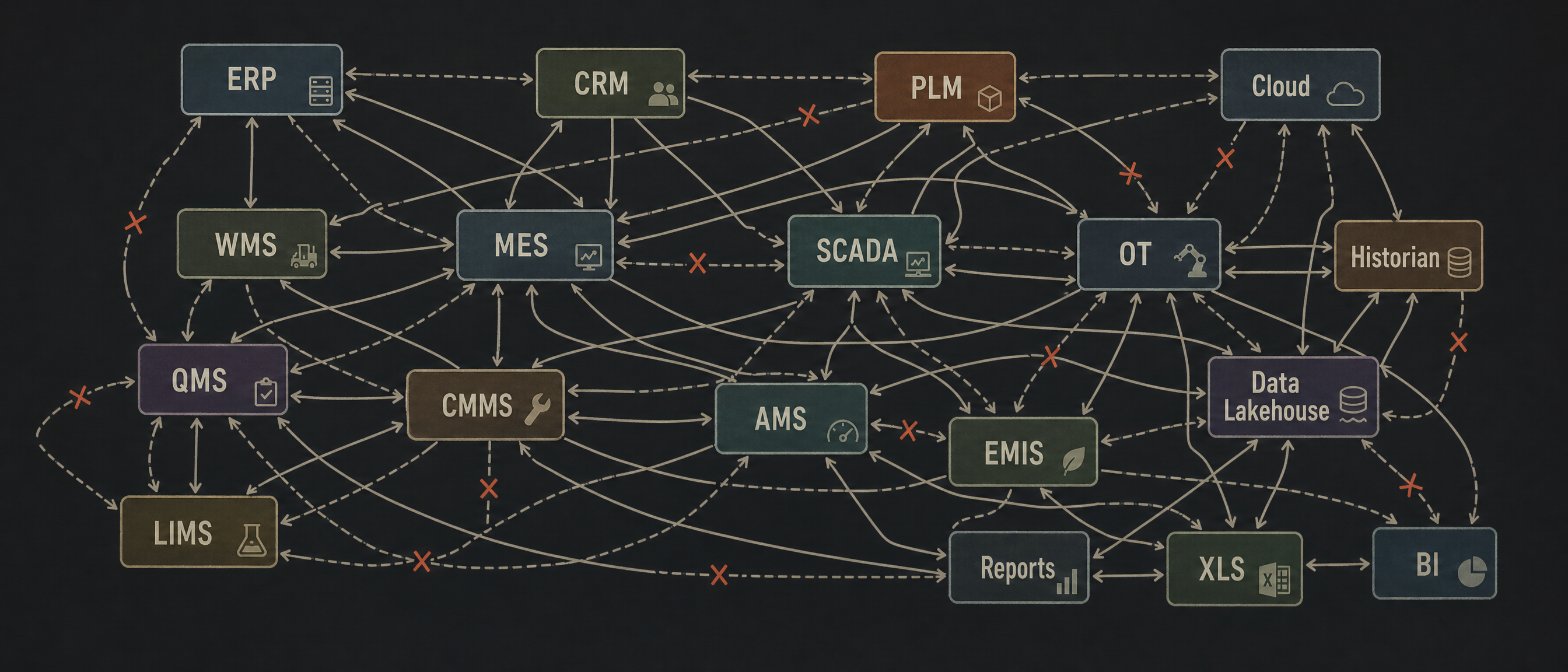
SCADA, MES, ERP, spreadsheets, and reports operate as separate islands.
Decisions depend on manual extraction and reconciliation.
Data exists, but context is trapped in people, screens, and local systems.
Industry 4.0
Connected and contextualized.
Assets, events, processes, products, and business context are connected.
Information is published, reused, governed, and consumed across functions.
Operations learn faster because current and historical state are available.
Comparison
The visible symptoms are easy to spot.
Dimension
Industry 3.0 Pattern
Industry 4.0 Pattern
Data movement
Point-to-point exports, polling, copy-paste, batch reports.
Event-driven publishing and governed consumption.
Context
Known locally by operators, engineers, and system owners.
Modeled as reusable asset, process, product, state, and business context.
Decision speed
Delayed by meetings, spreadsheets, and reconciliation.
Supported by current state and trusted historical evidence.
AI readiness
AI receives disconnected data and makes brittle recommendations.
AI consumes governed, contextualized, permissioned industrial information.
Migration Path
Move by strengthening the foundation.
Current stateMap the systems, data gaps, manual work, and decision bottlenecks.
Business valuePick use cases that matter enough to change behavior.
ConnectBring OT and IT sources into controlled visibility.
ContextNormalize names, states, assets, products, time, and events.
ExposeServe current and historical state to people and systems.
LearnImprove routines, automation, and decisions with evidence.